

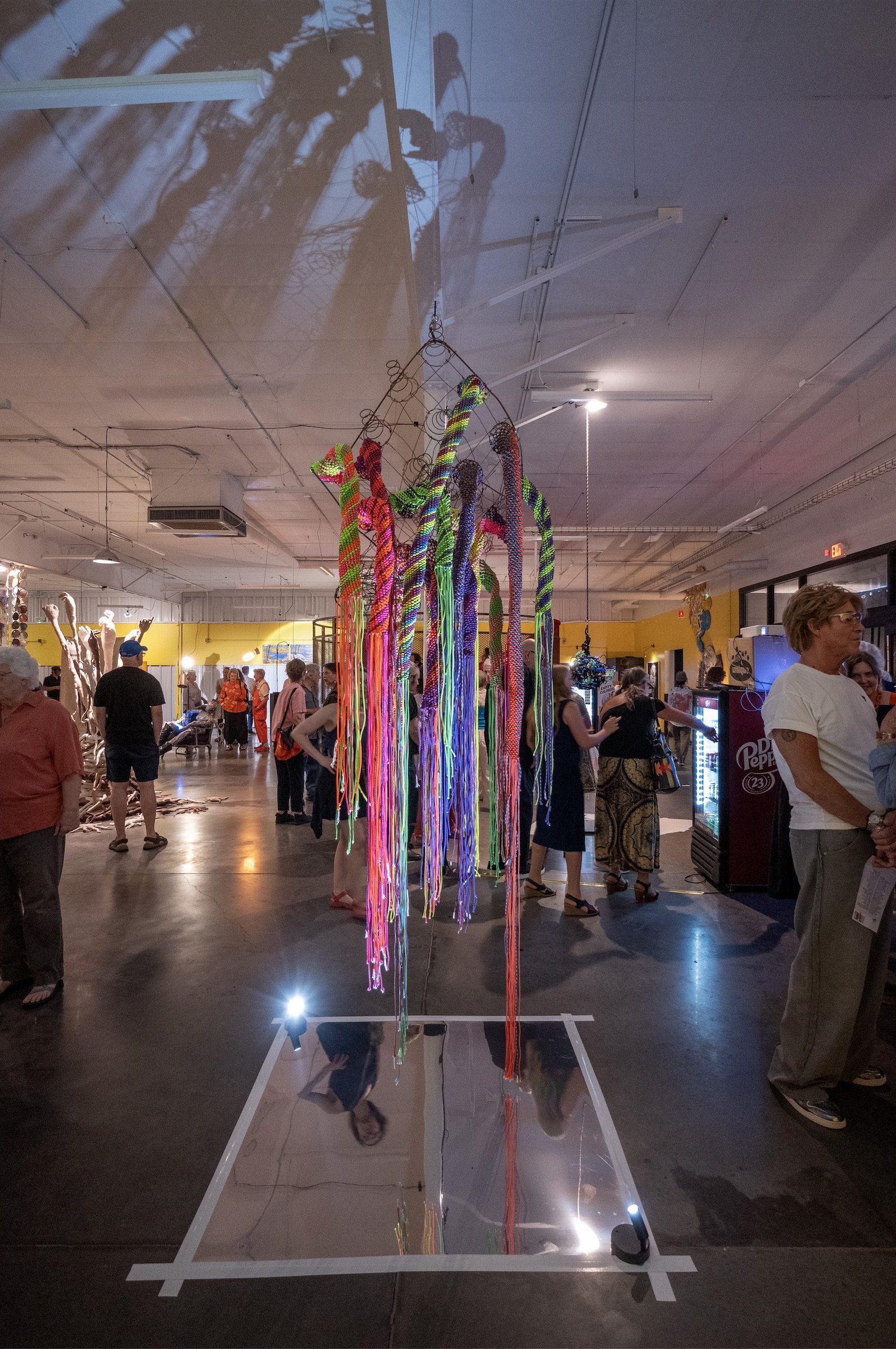
How We Transformed an Abandoned Dollar General into a Contemporary Art Exhibition
What happens when a vacant retail store becomes a temporary home for contemporary art? This behind-the-scenes account follows the transformation of a former Dollar General into Of Frame and Fallow, a Site Seen exhibition featuring the work of more than fifty artists.
Featured image: Exhibition view, Of Frame and Fallow, Site Seen, 2026 . Photography by Fred Hatt
When we first unlocked the doors, it didn't look like an art exhibition waiting to happen.
It looked exactly like what it had been.
A Dollar General.
The fluorescent lights still hung overhead. Bright yellow walls stretched around the perimeter of the building. Retail fixtures remained. The familiar geometry of discount commerce lingered in every aisle, even after the shelves themselves had disappeared.
Most people would have walked through the building and seen an empty store.
We saw a conversation waiting to happen.
That difference in perspective is where every Site Seen exhibition begins.
Looking Beyond Vacancy
Vacancy is often mistaken for absence.
A building sits empty for a few months, sometimes years, and gradually disappears from public attention. Yet buildings rarely become empty in the emotional sense. They continue to accumulate memory. Layers of occupation remain visible in worn floors, repaired walls, faded paint, forgotten fixtures, and the countless decisions made by people who passed through long before artists arrived.
The former Dollar General already possessed its own history.
Rather than concealing that history, we wanted the exhibition to exist because of it.
The building was never intended to become a neutral gallery.
It remained unmistakably itself.
Curating for a Building, Not Just a Theme
Every Site Seen exhibition begins with a site before it begins with artists.
Long before invitations were sent, we walked the building repeatedly. We watched how afternoon light entered through the storefront windows. We measured distances between columns. We noted sightlines, ceiling heights, hidden corners, and the subtle ways visitors might move through the space.
Only then did the curatorial framework begin to emerge.
Of Frame and Fallow invited artists to consider what remains after a place has been emptied, abandoned, or transformed. Memory, architecture, labor, resilience, ecology, ritual, and human presence became recurring threads, not because they had been assigned, but because the building itself suggested them.
The exhibition was shaped as much by the architecture as by the artworks it contained.
Fifty-One Artists, One Temporary Home
Bringing together more than fifty artists inside a single building is less like hanging an exhibition and more like composing an orchestra.
Every artwork influences those around it.
Scale matters.
Distance matters.
Light matters.
Some works required quiet.
Others demanded space.
Certain conversations between artworks emerged only after they occupied the same room.
Installing the exhibition became an act of continual adjustment. Sculptures shifted. Installations expanded. New relationships appeared unexpectedly as artists responded not only to the building, but to one another.
The exhibition gradually assembled itself through hundreds of small decisions.
A Building Changes Again
On opening night, visitors entered a place many already knew.
Some had shopped there.
Others had driven past it for years without noticing it.
Now they crossed the same threshold into something entirely different.
People wandered slowly.
They looked upward.
They paused.
Conversations happened between strangers.
Children moved through installations with curiosity rather than hesitation.
For a few hours, the building acquired a new identity.
Not permanently.
Just long enough to imagine another future.
Then It Was Gone
Temporary exhibitions carry their own kind of urgency.
Artists know the work will disappear.
Visitors understand the experience cannot simply be postponed until next month.
When Of Frame and Fallow closed, the installations came down. The lights were packed away. The building returned once again to waiting.
Yet something had changed.
The exhibition now exists in photographs, conversations, memories, and the work that artists carried forward into their studios.
The building continued its own journey.
So did everyone who passed through it.
Why We Keep Returning to Buildings Like This
People sometimes ask why Site Seen doesn't establish a permanent gallery.
The answer was visible throughout Of Frame and Fallow.
This exhibition could not have existed anywhere else.
Its meaning emerged through the dialogue between architecture, artwork, and the people who briefly shared the same space.
That conversation belongs to this building alone.
When it ended, it became part of the building's history.
And that, perhaps, is the most meaningful transformation of all.
About Of Frame and Fallow
Of Frame and Fallow transformed a former Dollar General in Esopus, New York, into a temporary contemporary art exhibition featuring fifty-one artists working across sculpture, installation, painting, photography, fiber, video, and mixed media. Presented by Site Seen in June 2026, the exhibition invited artists and visitors alike to reconsider vacancy not as an ending, but as a site of memory, possibility, and renewal.
About Inside Site Seen
Inside Site Seen is an ongoing editorial series exploring the ideas, places, artists, and processes behind Site Seen's temporary exhibitions. Together, these essays form an evolving archive of conversations about contemporary art, architecture, memory, and the overlooked buildings that briefly become sites of cultural exchange.