

What Is Site-Specific Art? Understanding Art Created for a Specific Place
A Site Seen Field Guide
We rarely think about the buildings we move through each day.
A grocery store. An office. A former bank. A marina waiting for its next tenant. A vacant storefront passed so often it becomes almost invisible.
We tend to experience these places as backdrops to ordinary life. We enter, complete a task, and leave, rarely noticing the layers of time accumulating around us. A repaired section of drywall. A threshold worn smooth by thousands of footsteps. Faded paint where shelving once stood. An abandoned electrical conduit that no longer leads anywhere.
Yet none of these details are accidental. Together, they form a quiet record of human presence.
Site-specific art begins by paying attention to what is already there.
Unlike artworks created independently of their surroundings, site-specific works are conceived in conversation with a particular place. The architecture is not simply where the artwork happens to be displayed. It becomes part of the artwork's language. Light, scale, history, sound, materials, memory, even the evidence left behind by previous occupants all contribute to what the work ultimately becomes.
Remove the work from that place and something essential disappears with it.
At Site Seen, this understanding shapes every exhibition we create. Before a single artwork is installed, before an exhibition has a title, before artists are invited into the space, we spend time listening. We walk the building. We notice how daylight moves across the floor. We look for traces of previous lives. We pay attention to what the building is already saying.
Because every place has a story long before art arrives.
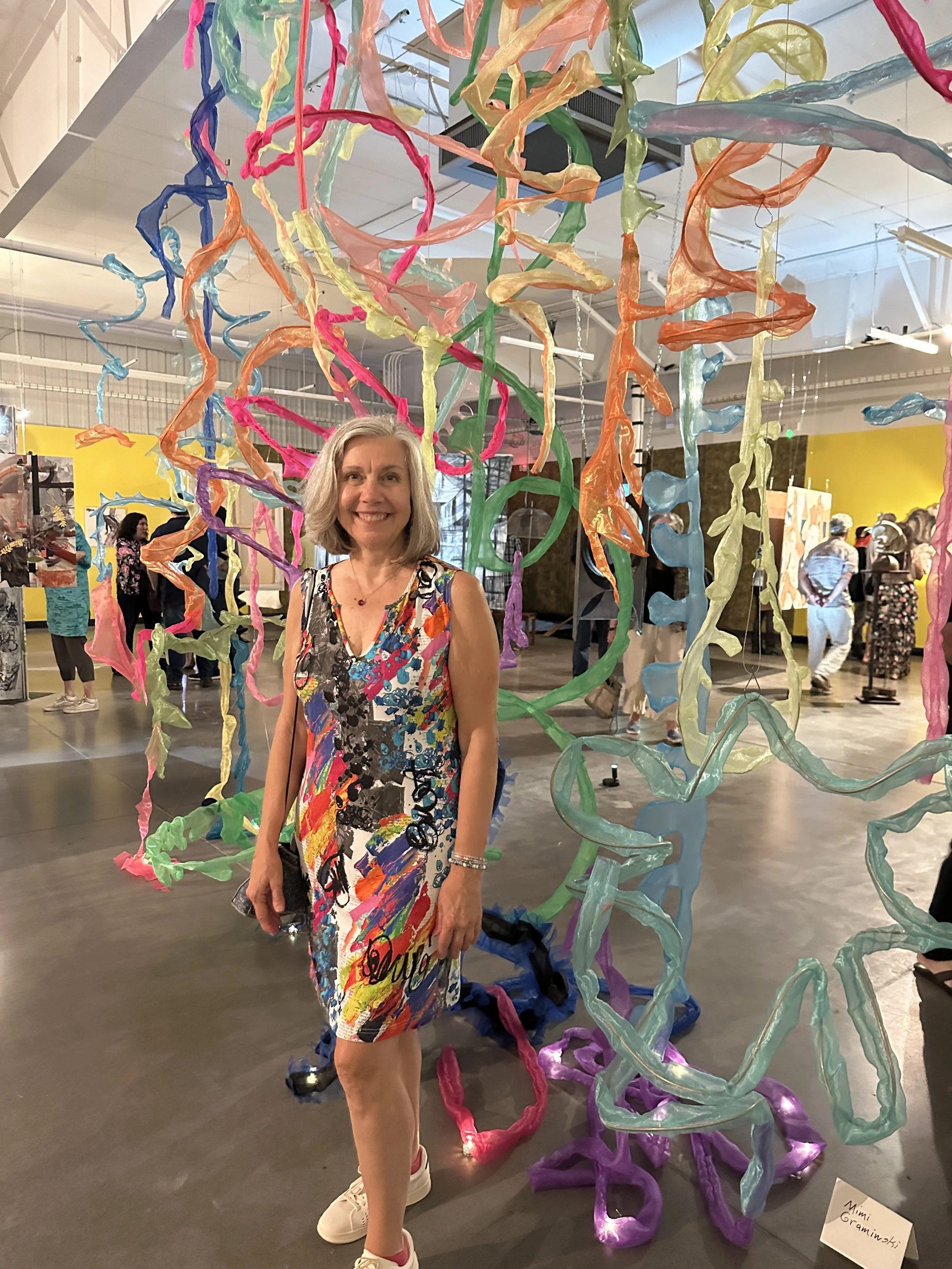
Mimi Graminski with her site-specific installation during Site Seen's Of Frame and Fallow, a temporary contemporary art exhibition presented inside a former Dollar General in Esopus, New York, 2026. Photograph by Natalya Khorover
A Place Is Never Neutral
One of the most persistent misconceptions about exhibitions is that the building exists merely to contain the artwork.
The familiar white gallery reinforces this idea. Walls are painted evenly. Windows are minimized. Floors become neutral. Everything encourages the viewer to focus entirely on the objects being displayed.
There is tremendous value in that approach.
But neutrality is also an illusion.
Every space shapes experience. Ceiling height changes the way we perceive scale. Sound alters our sense of distance. Light affects mood. Even the sequence of doorways influences how we encounter a work of art.
Site-specific artists begin with this reality rather than attempting to erase it.
Instead of asking how a building can disappear, they ask how the building itself might participate.
A cracked concrete floor becomes part of an installation. An old loading dock becomes a stage. Fluorescent lighting once designed to illuminate merchandise creates an unexpectedly cinematic atmosphere. A former dressing room becomes an intimate chamber for sound.
Architecture stops functioning as background.
It becomes collaborator.
Listening Before Making
Every building carries evidence of the lives that unfolded inside it.
Not dramatic histories.
Ordinary ones.
The place where customers paused while waiting in line. The wall repaired after years of use. The faded outline of a sign removed decades ago. Layers of paint revealing changing priorities. Small alterations made by people whose names will likely never be known.
These traces are remarkably similar to archaeological artifacts.
Individually they may seem insignificant.
Together they reveal patterns of human behavior.
At Site Seen, we often describe our process as listening before making.
Rather than arriving with a predetermined vision imposed upon a space, we allow the building itself to shape the conversation. The architecture suggests possibilities. The history introduces questions. The remaining material evidence provides both limitations and opportunities.
Artists respond not to an empty room but to a place already rich with accumulated meaning.
What Makes Site-Specific Art Different?
Many artworks can travel successfully from museum to museum without losing their essential character.
Site-specific works are different.
They emerge from relationships that cannot simply be packed into a crate.
A sculpture responding to the proportions of a former warehouse cannot be fully separated from those proportions. An installation built around the memory of a neighborhood changes when placed somewhere else. A sound work composed for the reverberation of concrete walls becomes something entirely different inside a carpeted gallery.
This does not make site-specific art better.
It makes it inseparable from its environment.
The work and the place complete one another.
Buildings Remember
Vacant buildings are often described as empty.
We see them differently.
A building between tenants is not without history. It exists in a brief period of transition where its previous identity remains visible while its future has not yet been written.
These moments are surprisingly fragile.
Renovation erases them.
Demolition eliminates them entirely.
Yet before either happens, there exists an extraordinary opportunity to encounter the building as it is.
Not preserved.
Not restored.
Simply acknowledged.
Temporary exhibitions allow us to inhabit that moment.
Rather than pretending the past never happened, they invite visitors to experience architecture carrying multiple lives at once.
The Site Seen Approach
Every Site Seen exhibition begins with a building.
Not because we are searching for unusual venues, but because we believe architecture is capable of shaping meaning as profoundly as any artwork.
A former tattoo parlor carries different emotional weight than a marina.
An abandoned Dollar General speaks differently than an empty office building.
We never ask artists to ignore those histories.
We ask them to engage with them.
Sometimes that dialogue is subtle.
Sometimes direct.
Sometimes the building quietly changes the way a work is perceived without visitors fully realizing why.
The exhibition becomes something that could not exist anywhere else.
When it ends, it disappears.
And that disappearance matters.
The building continues its own journey carrying one more layer of memory.
The artists move on.
Visitors remember not only individual works, but the experience of encountering them in a place that briefly became something entirely unexpected.
Why Site-Specific Art Matters
We live in a culture increasingly designed for efficiency.
Buildings are constructed to serve functions. Once those functions disappear, the structures themselves often fade from public attention.
Site-specific art asks us to slow down.
To notice.
To recognize that architecture is never merely physical shelter but a record of human activity, aspiration, failure, adaptation, and care.
When contemporary art enters these spaces, it does not erase what came before.
It reveals it.
Sometimes the most remarkable transformation is not what happens to the building.
It is what happens to the way we see it.
Related Reading
What Is Adaptive Reuse?
Why Context Changes the Meaning of Art
How Artists Transform Vacant Buildings
Temporary Art Exhibitions vs. Traditional Galleries
The Life Cycle of a Site Seen Exhibition