

Buildings Between Lives: Why Transitional Spaces Matter
A Site Seen Field Guide
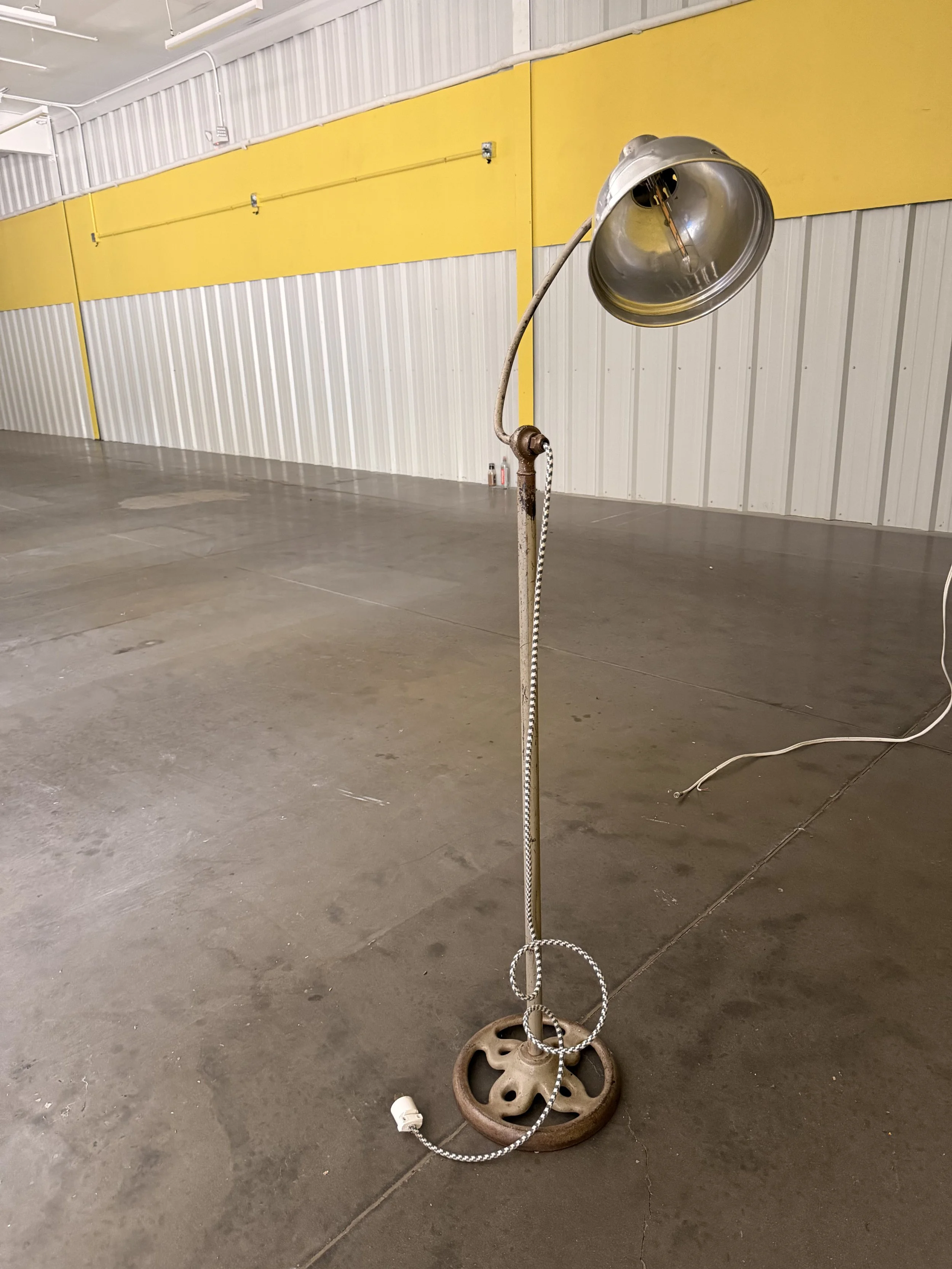
Vintage lamp in a transitional space in which Site Seen activated Of Frame and Fallow, a temporary contemporary art exhibition presented inside a former Dollar General in Esopus, New York, 2026. Photograph by Site Seen
We tend to think of buildings in fixed terms.
A grocery store.
An office.
A school.
A church.
A home.
We identify them by what they do, not by what they are.
But buildings are never fixed. Like the communities around them, they change over time. Businesses close. Families move. Industries evolve. Neighborhoods shift. Every building eventually reaches a moment when one chapter has ended and another has not yet begun.
Most of us barely notice these intervals.
At Site Seen, they are where our work begins.
The Space Between
When a building is no longer serving its original purpose, it is often described as empty.
The word suggests absence.
Silence.
Failure.
Yet step inside and another reality begins to emerge.
The building is still carrying everything it has experienced.
The floor records years of footsteps.
Walls reveal layers of repair and reinvention.
Light continues moving through windows exactly as it always has.
The architecture has not stopped living simply because people have stopped using it in the same way.
It is between lives.
Buildings Are Written Over Time
Unlike people, buildings do not remember through stories.
They remember through evidence.
A patched section of drywall.
An old electrical conduit leading nowhere.
A worn threshold polished by thousands of crossings.
Paint lines left behind after shelves were removed.
These are not imperfections waiting to be erased.
They are a record of occupation.
Every repair, every alteration, every improvised solution becomes part of the building's biography.
Much like an archaeological site, meaning accumulates layer by layer.
Nothing exists in isolation.
Everything belongs to a larger history.
Why Transitional Spaces Matter
The period between one use and the next is often remarkably short.
A lease is signed.
Construction begins.
Walls come down.
Fresh paint covers old surfaces.
The building prepares to introduce itself again under a different name.
There is nothing wrong with this.
Change is essential.
Communities grow because places continue adapting to new needs.
What fascinates us is the brief interval before that transformation is complete.
For a short time, the past remains visible while the future has not yet arrived.
Two identities occupy the same space.
Those moments rarely last.
Seeing What We Normally Overlook
Most of our lives are spent moving through architecture without really seeing it.
Buildings become background.
We notice them only when something demands our attention.
An exhibition has the power to interrupt that habit.
Visitors who enter a former retail store expecting to see art often leave talking about the building itself.
They notice the height of the ceilings.
The rhythm of the columns.
The quality of afternoon light.
The marks left behind by previous occupants.
Suddenly, architecture becomes visible again.
Not because it has changed.
Because our attention has.
Art Doesn't Replace a Building. It Reveals It.
People sometimes imagine that Site Seen transforms buildings into galleries.
We think the opposite is true.
The buildings transform the art.
A sculpture installed inside a former Dollar General carries different meaning than the same sculpture inside a museum.
A sound installation behaves differently in a marina than it would inside a white cube.
Architecture is never neutral.
It shapes movement.
Light.
Scale.
Memory.
The exhibition does not erase those qualities.
It brings them into sharper focus.
Not Ruin, But Renewal
Vacant buildings are often photographed as symbols of decline.
Broken windows.
Peeling paint.
Empty rooms.
There is an entire visual language devoted to abandonment.
That has never been our interest.
Site Seen is not drawn to buildings because they are deteriorating.
We are drawn to them because they are changing.
These are not forgotten places.
They are places preparing to become something else.
The interval between those identities deserves attention, not because it is permanent, but precisely because it is not.
A Different Kind of Public Space
For a brief time, a building that was once closed becomes open again.
Neighbors walk through spaces they thought they knew.
Former customers return.
Children bring their parents.
Artists encounter architecture they would never have chosen to build from scratch.
Property owners see familiar spaces through unfamiliar eyes.
An ordinary building briefly becomes a place of shared curiosity.
That transformation is temporary.
Its impact often is not.
Before the Next Chapter
Eventually every building moves on.
New tenants arrive.
Construction begins.
Fresh paint conceals old walls.
Another story starts.
That is not something to resist.
It is simply another chapter in the life of the building.
Site Seen exists to acknowledge the chapter that comes before.
The quiet interval that is so often overlooked.
The moment when the past remains visible, the future remains uncertain, and architecture has one last opportunity to tell the story of where it has been.
Sometimes all it asks is that we stop long enough to listen.
Continue Exploring
What Is Site-Specific Art?
What Is Adaptive Reuse?
Why Context Changes the Meaning of Art
Why Do Artists Transform Vacant Buildings?
What Makes Installation Art Different from Sculpture?