

When Architecture Becomes a Curator
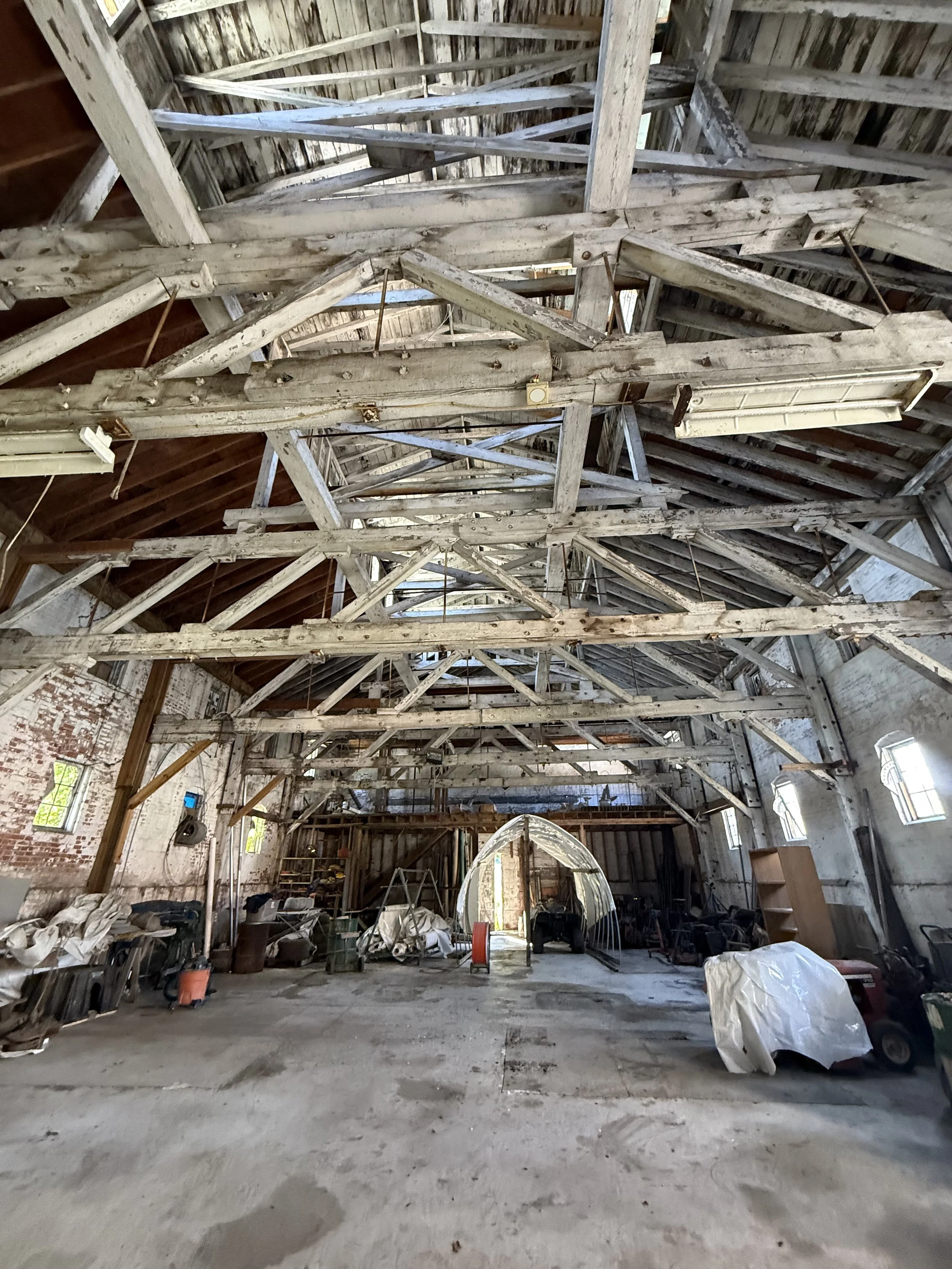
Interior of the former industrial marina building that housed Of Hull and Hush, Site Seen's October 2025 contemporary art exhibition in Connelly, New York. The building's architecture informed the exhibition's curatorial approach and visitor experience. Photograph by Site Seen
How Buildings Become Active Collaborators in Contemporary Exhibitions
Every exhibition begins with a room.
Ours begins with a building.
Before we invite a single artist, we spend time walking through vacant storefronts, warehouses, offices, schools, churches, marinas, and other transitional spaces. We pay attention to the things many people overlook: the quality of light, the rhythm of columns, worn concrete, timber trusses, patched walls, unusual acoustics, unexpected sightlines, and the traces left behind by previous occupants.
Those conditions are not obstacles.
They are the beginning of the exhibition.
For generations, galleries have been designed to disappear. White walls, controlled lighting, and carefully proportioned rooms create neutral environments where attention rests almost entirely on the artwork.
It is an elegant solution.
But it is only one way to curate.
At Site Seen, architecture is never neutral.
Every building arrives with its own character. A former grocery store carries different memories than a marina building. An abandoned office invites different conversations than an empty church or warehouse. Long before the artwork arrives, the building has already begun telling its own story.
Rather than asking architecture to step aside, we invite it into the curatorial process.
The building begins making decisions alongside us.
A soaring ceiling encourages ambitious installations. Narrow corridors slow movement and create moments of intimacy. Large storefront windows connect the exhibition to the surrounding community. Weathered brick, aging timber, industrial steel, and changing daylight become part of the visual language of the work itself.
Architecture doesn't simply contain the exhibition.
It shapes it.
That changes every curatorial decision we make.
Instead of developing an exhibition and searching for a place to install it, we begin by understanding the place itself. We ask what kinds of artwork belong there, what conversations the building already suggests, and how artists might respond to its history, scale, materials, and atmosphere.
The exhibition gradually emerges from those observations.
Artists often discover possibilities they hadn't anticipated. Works conceived for white walls take on new meanings against weathered surfaces. Installations grow larger, quieter, or more immersive because the building asks something different of them.
Visitors experience that collaboration as well.
Most people know how to behave inside a museum. A former marina, department store, office building, or neighborhood storefront invites a different kind of attention. People arrive carrying memories of those places. The architecture feels familiar, even when the experience unfolding inside is entirely unexpected.
The building becomes part of how the artwork is understood.
This is why Site Seen isn't interested in vacant buildings simply because they are vacant.
We're interested in buildings between lives.
Places waiting for their next purpose.
Buildings suspended between one identity and another.
For a brief period, architecture is free to participate in something entirely new.
Contemporary art becomes one chapter in the life of the building, and the building becomes one collaborator in the life of the exhibition.
When the exhibition closes, the building moves forward.
A new tenant arrives.
Renovations begin.
The lights change.
The architecture continues its story.
The exhibition disappears.
But the relationship between place, memory, and community lingers long after the artwork has gone.
Because the most memorable exhibitions don't simply occupy a building.
They allow the building itself to become part of the art.