

What Is Curating?
A Site Seen Field Guide
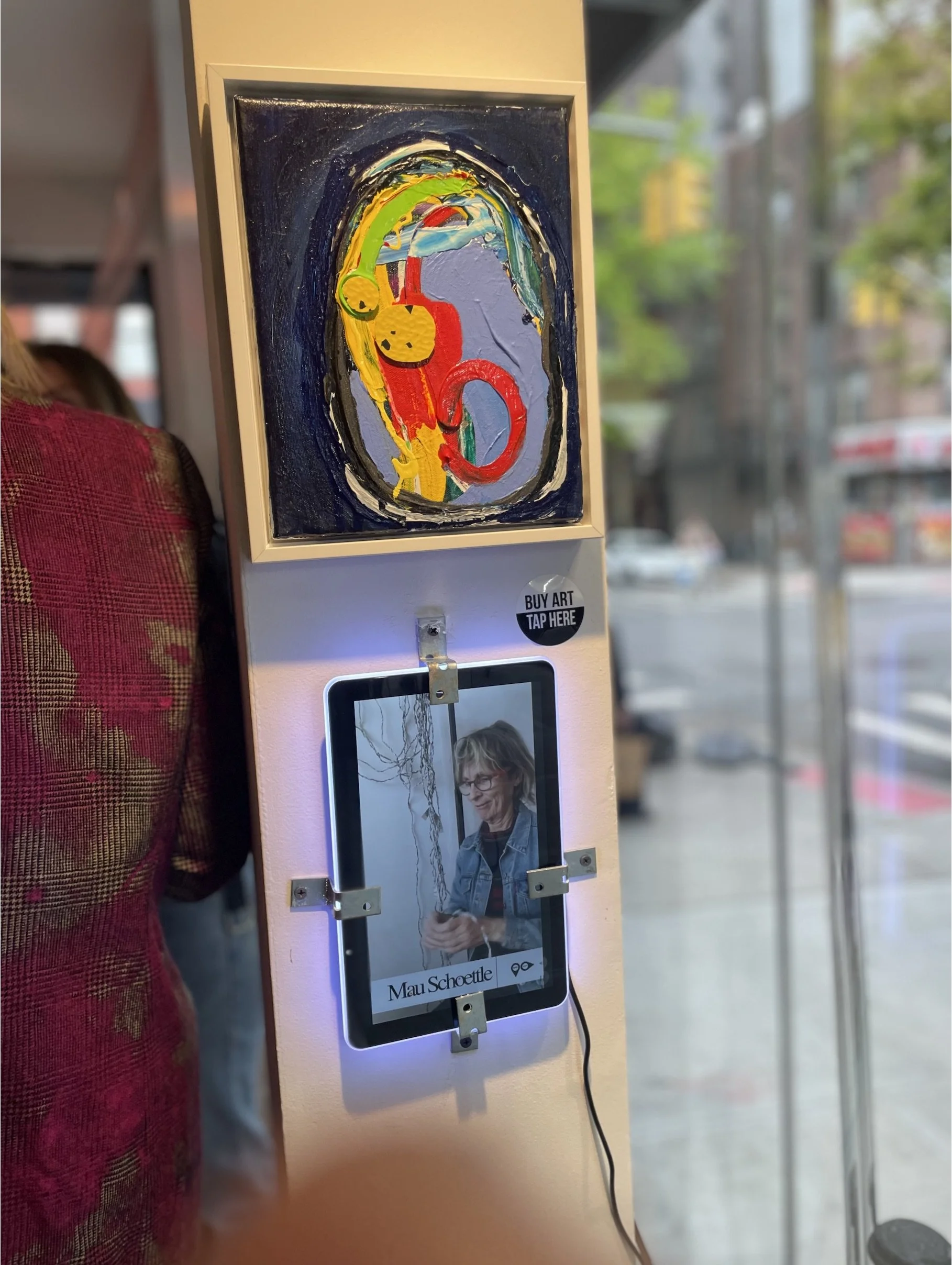
Digital artist interpretation accompanying installation art by Mau Schoettle (not shown in photo) at Of Grit and Grid, Site Seen's 2026 exhibition in Brooklyn, New York. Contemporary curating creates new ways for visitors to engage with artists and their work. Photograph by Site Seen
A Guide to Contemporary Curatorial Practice
When most people hear the word curator, they imagine someone selecting paintings for a museum or deciding where sculptures should be placed in a gallery.
Selection is certainly part of the role.
But contemporary curating is much broader than choosing artwork.
Curating is the practice of developing ideas, organizing relationships between artworks, artists, architecture, and audiences, and shaping the overall experience of an exhibition. A curator doesn't simply decide what people see. They help determine how and why they experience it.
Where Does the Word "Curator" Come From?
The word curator comes from the Latin curare, meaning "to care."
Historically, curators were responsible for caring for museum collections by preserving, researching, documenting, and displaying objects.
Today, the profession has expanded dramatically.
Curators work in museums, galleries, artist-run spaces, universities, biennials, sculpture parks, public art organizations, historic sites, and increasingly, in places never intended to become exhibition spaces.
What Does a Curator Actually Do?
Every exhibition involves hundreds of decisions.
A curator may:
Develop the exhibition's central concept.
Research artists and historical context.
Visit artists' studios.
Select participating artists and artworks.
Determine how works relate to one another.
Design the visitor's experience through the space.
Write exhibition texts and catalog essays.
Collaborate with architects, designers, installers, and fabricators.
Organize public programs, talks, and educational events.
Consider accessibility, interpretation, and community engagement.
Good curating is rarely about individual artworks alone.
It is about creating meaningful relationships between people, ideas, and place.
Contemporary Curating Goes Beyond the Museum
Today's curators often work far outside traditional gallery settings.
Contemporary exhibitions can take place in parks, historic buildings, former factories, storefronts, schools, churches, industrial sites, train stations, and other unexpected locations.
These spaces aren't simply alternative venues.
They often become part of the exhibition itself.
Architecture, history, natural light, acoustics, neighborhood context, and previous uses all influence how visitors experience the artwork.
What Is Site-Specific Curating?
Site-specific curating begins with a place rather than a floor plan.
Instead of asking, "Where can this exhibition fit?", the curator asks:
What is unique about this building?
What stories does this place already contain?
How can artists respond to its architecture and history?
What kinds of experiences are only possible here?
The exhibition develops in conversation with the site.
Rather than disappearing into the background, architecture becomes an active collaborator in the curatorial process.
Curating in Transitional Spaces
An increasing number of curators are working inside buildings that are temporarily vacant or awaiting their next chapter.
Former grocery stores.
Warehouses.
Factories.
Office buildings.
Marinas.
Retail spaces.
These environments offer opportunities that conventional galleries often cannot.
Large-scale installations become possible.
Visitors experience familiar places in unfamiliar ways.
Communities reconnect with buildings that have quietly disappeared from everyday attention.
The exhibition becomes part of the building's continuing story.
How Site Seen Approaches Curating
At Site Seen, every exhibition begins with a building.
Before artists are invited, we spend time observing the architecture, history, proportions, and atmosphere of a place. Those qualities shape every curatorial decision that follows, from artist selection to installation design.
Rather than treating architecture as a neutral backdrop, we approach each building as an active collaborator.
Every exhibition is developed specifically for its site.
No two are ever the same.
Why Curating Matters
Curating shapes the way we encounter contemporary art.
Thoughtful curatorial practice creates connections between artworks, artists, architecture, communities, and ideas that might never emerge on their own.
At its best, curating doesn't simply organize an exhibition.
It changes the way we see.
Related Reading
When Architecture Becomes a Curator
How an Empty Building Becomes an Exhibition
Why Place Still Matters
What Is Site-Specific Art?
What Is Adaptive Reuse?