

Why We Don't Cover the Scars
Walk through almost any contemporary gallery and you'll notice what isn't there.
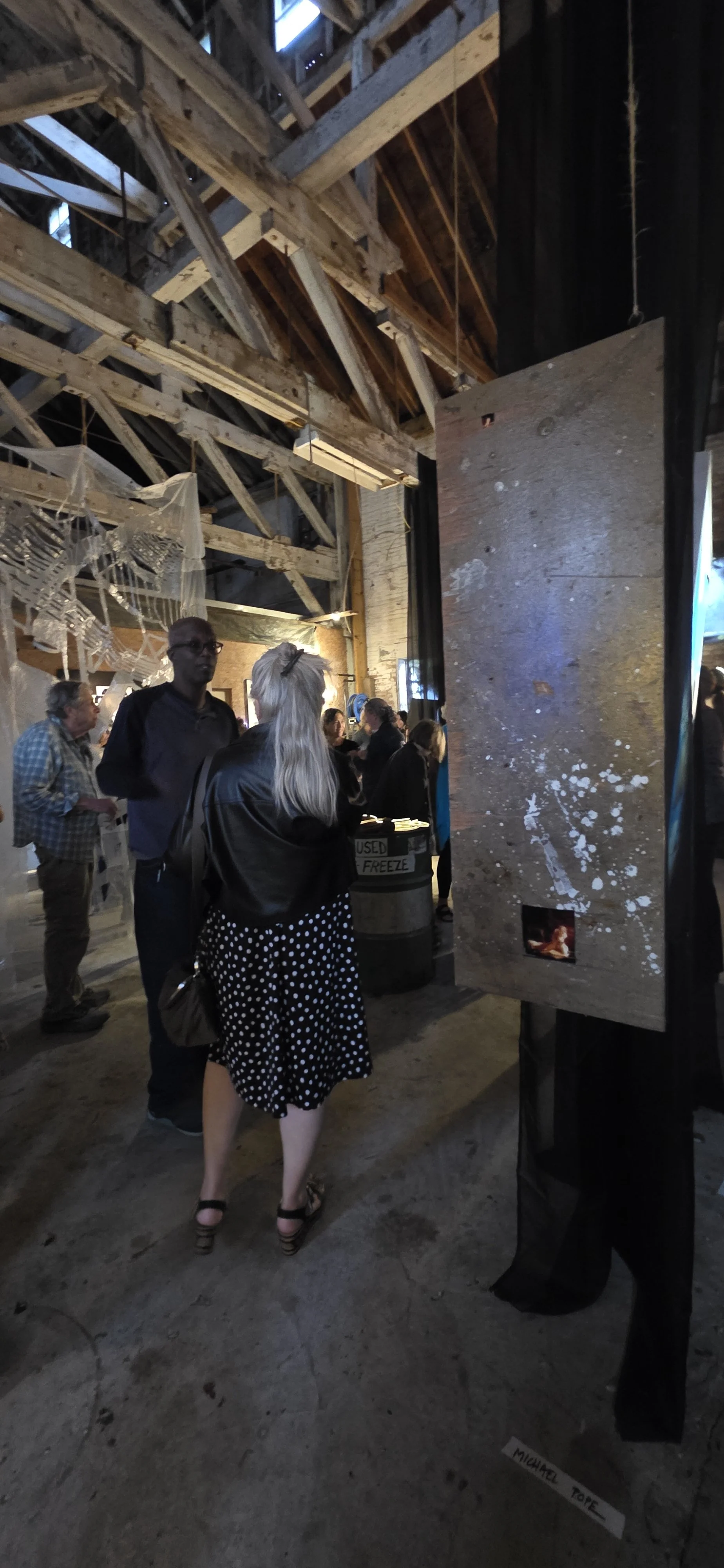
Visitors explore Of Hull and Hush inside a former marina in Connelly, NY, where the building's exposed timber structure, weathered surfaces, and industrial character remained an integral part of the exhibition rather than a backdrop to be concealed. Photograph by Site Seen
Walls are smooth and freshly painted. Floors are immaculate. Every surface has been carefully controlled so that nothing competes with the artwork.
Our exhibitions begin from a different premise.
When we enter a building, we're not looking for flaws to conceal. We're looking for evidence.
A patch of mismatched paint tells us where a wall was repaired years ago. Hundreds of tiny screw holes suggest shelves that once held products now long forgotten. Scuffed concrete marks the paths people walked every day. Faded lettering on a window hints at businesses that have come and gone.
These are not distractions.
They are the building's memory.
Temporary spaces possess something purpose-built galleries rarely can: layers of accumulated history. Every tenant leaves behind small traces, whether intentionally or not. Over time, those traces form a quiet record of occupation, adaptation, and change.
It can be tempting to erase those marks in pursuit of a clean slate. Fresh paint promises neutrality. New drywall offers perfection. Yet in doing so, we often remove the very qualities that make a place unique.
At Site Seen, we choose a different approach.
Rather than covering the building's history, we allow artists to work alongside it. A sculpture might sit beneath faded retail signage. A projection may illuminate a cracked plaster wall. An installation may occupy the footprint of a former checkout counter or office. The architecture remains present, not as background decoration but as an active participant in the exhibition.
This doesn't mean preserving every imperfection without thought. It means asking what each surface contributes before deciding whether it should change.
Sometimes a damaged wall reveals decades of renovation beneath its layers of paint. Sometimes an old electrical panel quietly anchors an entire room. Sometimes a worn floor carries the rhythm of thousands of footsteps that came long before the exhibition arrived.
These elements remind visitors that the building has lived many lives.
The artworks enter into conversation with those lives rather than replacing them.
This philosophy extends beyond aesthetics. Reusing existing spaces and working with what is already present reduces waste, minimizes unnecessary construction, and encourages a more thoughtful relationship with the built environment. Instead of treating every exhibition as something that must begin from zero, we recognize the value already embedded in the architecture.
There is also a different kind of beauty in incompleteness.
A repaired wall carries the story of someone who chose to mend rather than replace. Weathered paint records years of sunlight. An abandoned sign reminds us that every building exists within a much longer timeline than any single exhibition.
These are not scars to hide.
They are evidence that a place has been inhabited, altered, cared for, and continuously transformed.
When visitors step into one of our exhibitions, they are encountering more than contemporary art. They are entering a conversation between artists, architecture, and the many people who occupied the space before either arrived.
For us, those conversations begin by leaving the scars exactly where we found them.
Continue Exploring
What Is Site-Specific Art?
What Is Adaptive Reuse?
Why Context Changes the Meaning of Art
Why Do Artists Transform Vacant Buildings?
What Makes Installation Art Different from Sculpture?